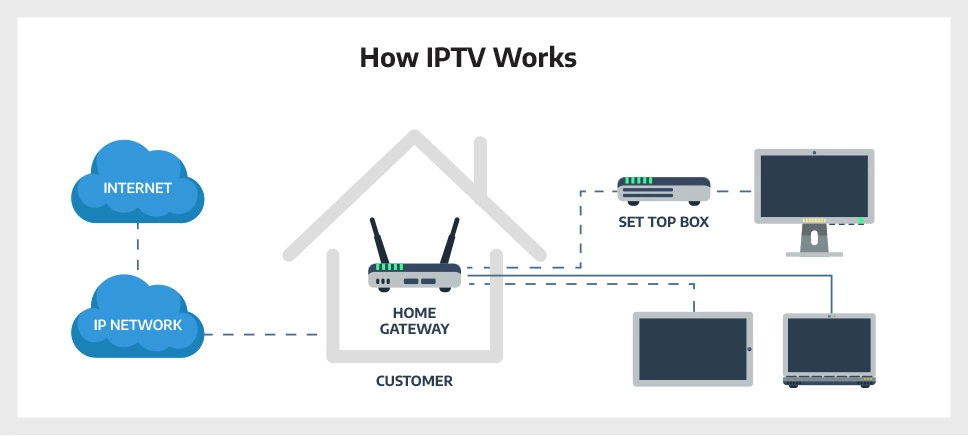
 Internet Protocol Television, commonly known as IPTV, is a method of delivering television and video services using Internet Protocol (IP) networks rather than traditional terrestrial, satellite or cable broadcasting systems.
Although IPTV is sometimes used as a general term for watching television through an internet connection, technically the concept is more specific. IPTV systems can use managed network infrastructure designed to control factors such as service quality, reliability, security and the viewer experience.
How IPTV Works
Traditional television distribution sends programming through terrestrial transmitters, satellites or cable networks. IPTV converts television and video into digital data that can be transported using IP-based networks.
An IPTV ecosystem can include content providers, service providers, network infrastructure and consumer devices.
At the viewer’s end, the service may be accessed through a set-top box, compatible television, computer or another supported device. The receiving device processes the incoming video stream and presents it to the viewer.
IPTV systems can provide several types of television services, including live television, video on demand and other interactive or data-based services.
Live Television and Video on Demand
Different delivery methods can be used depending on the type of service.
Live television needs to distribute the same program to potentially many viewers simultaneously. Network technologies such as IP multicast can therefore be used in managed IPTV environments to distribute television efficiently.
Video on demand works differently because individual viewers select what they want to watch and when they want to watch it. This generally requires an individual stream to be delivered to the viewer.
Modern IPTV standards support both linear television and video-on-demand applications.
IPTV and OTT Streaming Are Not Necessarily the Same
One of the most common misconceptions surrounding IPTV is that every television service delivered through the internet is IPTV.
Traditional IPTV is generally associated with a managed service environment in which the operator has greater control over content delivery, network performance and quality of service.
Over-the-top, or OTT, streaming services normally deliver video using the public internet without requiring the broadband network itself to be operated by the streaming provider.
From a consumer’s perspective, the experiences can appear similar: both allow video to be watched through an internet-connected device. Their underlying distribution architectures, however, can be different.
IPTV Standards
International standards organizations have developed technical recommendations for IPTV systems.
The International Telecommunication Union’s Telecommunication Standardization Sector (ITU-T) has published recommendations covering IPTV architecture, terminal devices, multimedia services, security and quality of service.
For example, ITU-T Recommendation H.721 describes functionality for IPTV terminal devices capable of receiving linear television and video-on-demand services through managed content-delivery environments.
The recommendation incorporates technologies including High Efficiency Video Coding (HEVC), Dynamic Adaptive Streaming over HTTP (DASH), Advanced Audio Coding (AAC) and other technologies used in modern multimedia distribution.
The European Telecommunications Standards Institute (ETSI) has also published specifications related to Digital Video Broadcasting over IP networks. DVB-related IPTV specifications cover areas including live media broadcasting, content on demand and content downloading.
IPTV Architecture
An IPTV service can be understood as several interconnected layers.
Content originates with broadcasters, studios or other authorized content providers. The television or video material is prepared for digital distribution through processes such as encoding and compression.
The service provider then manages how that content is made available to subscribers.
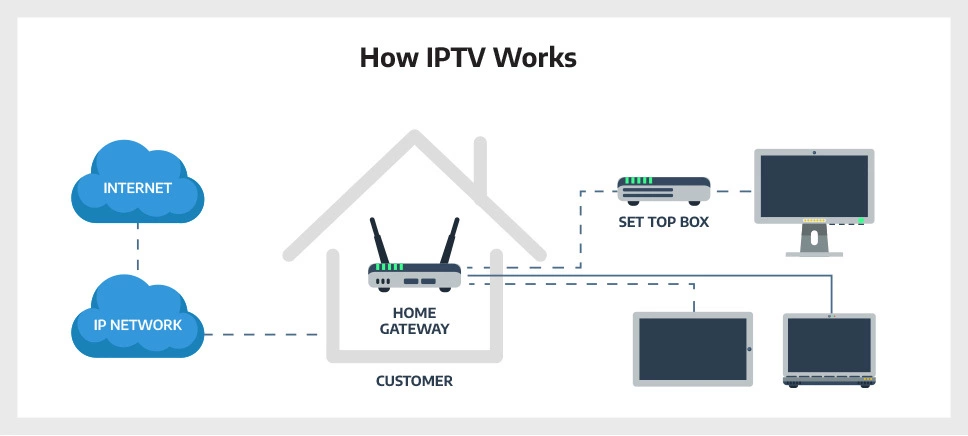
Network infrastructure transports the video streams between the service platform and viewers. Depending on the implementation, this infrastructure may include content-delivery systems, broadband networks, routers and other network components.
Finally, consumer equipment receives and decodes the stream.
This separation between content, service, network and consumer components allows IPTV platforms to support different network configurations and business models.
Why Network Management Matters
Video is particularly sensitive to network conditions.
Insufficient bandwidth, packet loss, congestion or excessive latency can cause buffering, reduced picture quality and interruptions.
For this reason, network management has historically been an important distinction between IPTV and ordinary internet video.
The ITU definition of IPTV specifically emphasizes IP-based networks that are managed to provide appropriate levels of quality of service, quality of experience, security, interactivity and reliability.
IPTV Devices
Early IPTV deployments commonly relied on dedicated set-top boxes connected to television sets.
Modern implementations can support a broader range of equipment, depending on the provider and network architecture. These may include smart televisions and other IP-connected multimedia devices.
Standards for IPTV terminal equipment help define how devices receive and process television services and provide interoperability between different parts of the IPTV ecosystem.
The Continuing Evolution of IPTV
IPTV developed alongside improvements in broadband infrastructure and digital video compression.
More efficient video codecs have made it possible to deliver higher-quality video using less bandwidth, while faster broadband networks have expanded the types of television and multimedia services that can be distributed through IP networks.
IPTV technology has consequently evolved beyond simply reproducing traditional television over a different network. Modern standards encompass live broadcasting, on-demand content, interactive applications, service discovery, accessibility, content protection and increasingly sophisticated multimedia experiences.
As broadband networks and video technologies continue to develop, the distinction between traditional IPTV, internet television and OTT streaming is becoming less visible to consumers, even though important differences remain in their underlying network architectures and service-delivery models.
References
International Telecommunication Union (ITU-T). IPTV Terminal Devices: Basic Model — Recommendation H.721.
International Telecommunication Union (ITU-T). Requirements and Architecture for Open IPTV Multicast Service — Recommendation H.705.3.
International Telecommunication Union. Standardizing IPTV, ITU News.
European Telecommunications Standards Institute (ETSI). Digital Video Broadcasting (DVB); DVB-IPTV Profiles for TS 102 034.
European Telecommunications Standards Institute (ETSI). Digital Video Broadcasting system specifications.